Browse

Latest Headlines

Fresh headlines, crisp visuals — faster reading.

The Surprising Truth About Which Egg Cracks First New

The Surprising Truth About Which Egg Cracks First

At first glance, this puzzle looks like a simple question about height.Egg A falls 1 meter onto dry sand.Egg B falls 2 meters onto a soft pillow.Egg C falls 1 meter onto a thick carpet.So which egg is most likely to crack first?The key is that the height is only part of the puzzle.What really matters when an egg hits a surface is how quickly the egg is stopped.An egg falling from a greater height reaches a higher speed before it hits the surface.That means Egg B is moving faster than Eggs A and C when they reach their surfaces.In fact, ignoring air resistance, an object dropped from 2 meters reaches about √2 times the speed of one dropped from 1 meter.So Egg B has more impact energy to deal with.However, the pillow is designed to absorb and spread out that impact.When Egg B hits the soft pillow, the pillow compresses and slows the egg down over a longer distance.That reduces the sudden force acting on the eggshell.So even though Egg B falls from twice the height, the soft pillow can protect it from a sharp impact.Now look at Egg A.It falls only 1 meter, so its impact speed is lower than Egg B’s.More importantly, the dry sand can move and deform when the egg lands.Instead of stopping the egg suddenly, the sand gives way underneath it.The egg can sink slightly into the sand, which helps spread the stopping process over a longer distance.This reduces the peak force on the shell.That makes dry sand a relatively forgiving surface for a falling egg.Egg C is also dropped from only 1 meter.Its impact speed is therefore about the same as Egg A’s.But there is an important difference between the two surfaces.A thick carpet can provide some cushioning, but it generally does not deform as freely as loose sand or a soft pillow.The egg still comes to a relatively sudden stop when it reaches the carpet.The exact result would depend on the type of carpet, what is underneath it, the thickness of the padding, the depth of the sand, and how soft the pillow is.So in a real experiment, these details could change the result.But based on the conditions shown in the picture, the intended answer is Egg C.Egg C has enough impact speed from the 1-meter drop to create a strong force, while its surface provides less energy absorption than the loose sand under Egg A or the soft pillow under Egg B.The interesting trick is that the highest drop does not automatically mean the egg will crack first.The surface underneath the egg is just as important as the height.A soft surface increases the distance and time over which the egg stops, reducing the peak force.A harder surface stops it more suddenly, which puts more stress on the shell.So, based on the setup shown, Egg C — the egg falling onto the thick carpet — is the most likely to crack first.

Sep 29, 2026
Can You Solve the Mystery of the Missing Chicken Head? New

Can You Solve the Mystery of the Missing Chicken Head?

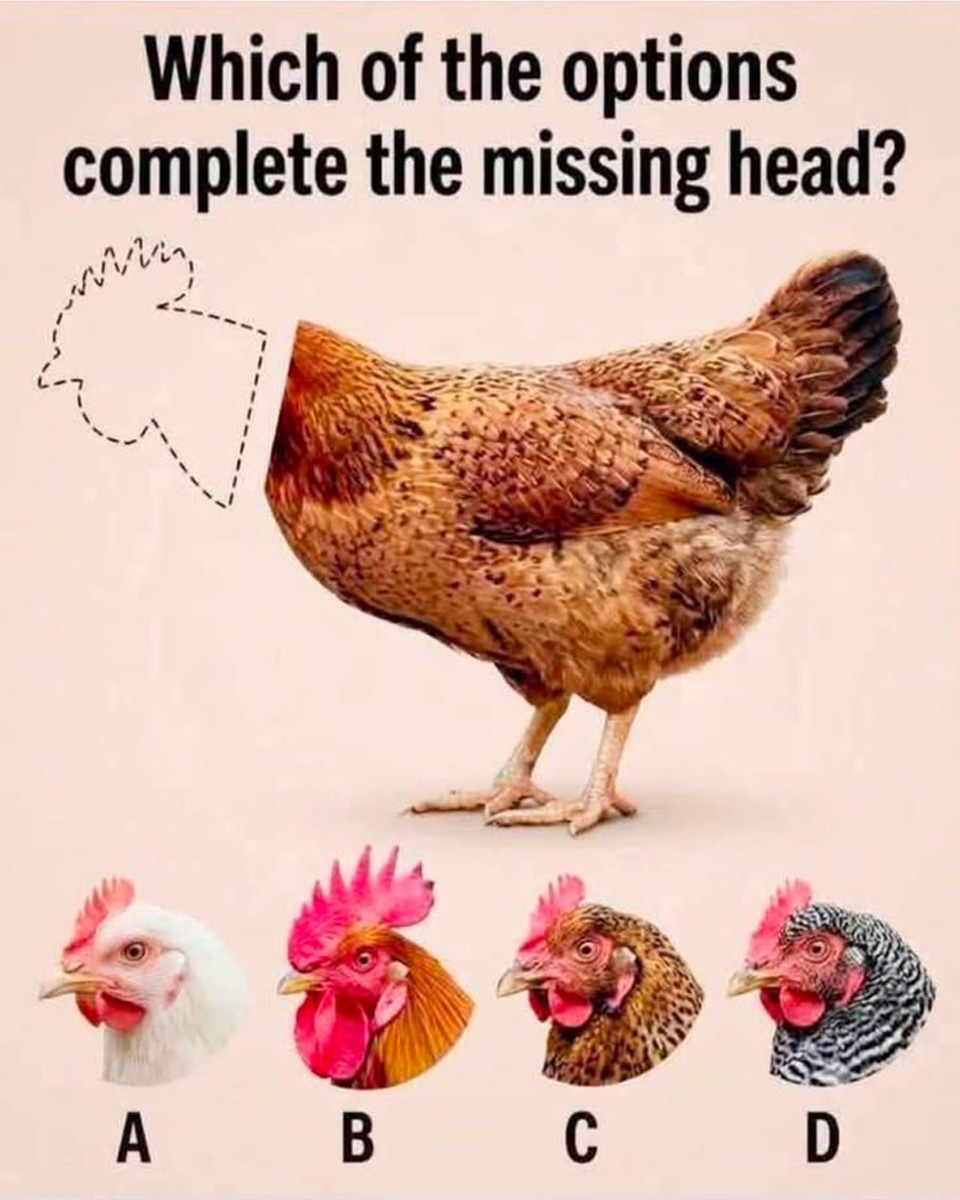
Hey everyone, welcome back to another fun visual puzzle that will test your observation skills today!Are you ready to give your brain a quick and entertaining workout?Puzzles like this one are a great way to take a short break and sharpen your eyes.Let’s take a look at the image above and see what we have here.We can see a healthy, brown-feathered chicken standing right in the center.However, if you look closely at the front, something very important is clearly missing!The poor chicken does not have a head attached to its body.Instead, there is only a dashed outline showing where the head should go.Your mission today is very simple: you need to help us find the perfect head to complete this picture.Below the chicken, we have four different options labeled A, B, C, and D.At first glance, all of these options look like normal chicken heads, but they are all quite different from each other.Option A shows a head covered in smooth, pure white feathers with a red comb on top.Option B features a very bright red comb with golden-yellow and orange feathers around the neck.Option C has a warm mix of brown, gold, and dark speckled feathers that look very detailed.Option D displays a unique pattern of black and white striped feathers all over the head.Each of these choices brings something unique to the table, but only one is the true match.To solve this riddle correctly, you need to pay close attention to the details of the chicken’s body.Take a good look at the colors and patterns on the torso and wings.Notice the shade of brown, the texture of the feathers, and how the neck area looks.Which head do you think seamlessly connects with the body in terms of color, pattern, and style?Does the white head fit, or does the bright yellow one make more sense?Or maybe the brown speckled one or the black-and-white striped head is the right choice?Don’t rush through it—take a few moments to carefully examine every single option.Trust your eyes, compare the textures, and see which piece completes the puzzle naturally.Once you think you have found the correct answer, let us know in the comments below!We would love to see how fast you were able to spot the right match today!ANSWER:

Sep 29, 2026
The $28,000 Demand That Revealed My Husband's Double Life New

The $28,000 Demand That Revealed My Husband's Double Life

When I refused to pay $28,000 for my mother-in-law’s European vacation, my husband struck the kitchen counter, kno:cking hot tea across me. Then he pointed at the door and shouted, “Transfer the money now, or get out of this house!” So I quietly packed one suitcase and left with a slim blue folder he had never bothered to read. The next morning, he arrived with his mother, expecting my apology and her vacation money. But the moment he saw where I was standing and the document in my hands, his face went pale.My name is Mara Bennett, and I had been married to Caleb Rowe for 7 years.Caleb had not always treated me that way. When we met, he was charming, ambitious, and attentive. He remembered how I took my coffee and spoke passionately about the consulting company he planned to build.My grandmother, Estelle, once warned me not to confuse confidence with character.“Watch how a man behaves when someone tells him no,” she said. “That is when you meet the person beneath the charm.”That morning, I finally understood her.Caleb’s mother, Vivian, sat at our kitchen island in an immaculate cream suit, studying a glossy travel brochure.“Mom has chosen her itinerary,” Caleb announced.The trip included business-class flights, luxury hotels in Paris and Rome, private tours through Florence, and a Mediterranean cruise.“The full package is $45,840,” he explained. “The $17,840 deposit has already been secured. There’s only $28,000 left to pay.”“Who paid the deposit?” I asked.“Mom handled it.”Vivian smiled. “I couldn’t risk losing the reservations while you were taking your time.”“I never agreed to pay for this trip.”Caleb laughed as though I were joking.“You said we would discuss it.”“We just did. My answer is no.”His smile vanished.Vivian slowly lowered the brochure.“You earn more than enough,” she said.“That doesn’t make my money yours.”“You’re my wife,” Caleb snapped. “Stop acting like your money has nothing to do with me.”I had spent years financing his definition of marriage.When his 1st business failed, I covered the mortgage for nearly 2 years. When Vivian needed dental work, I paid the bill. When her roof needed replacing, I paid for that too. I had even invested $185,000 to rescue Caleb’s company.Every request was presented as an emergency.Caleb called it partnership.Vivian called it my responsibility.But the vacation was not the only reason I refused.Two weeks earlier, I had discovered that Caleb had transferred $40,000 from our joint emergency fund.The money disappeared through 4 payments labeled consulting expenses, vendor costs, business development, and client accommodation.When I asked whether his company was having financial trouble, Caleb said no.His answer made me investigate.I found unexplained charges from a local hotel and a luxury retailer. I also discovered a $12,000 transfer to Cedar Coast Events, a travel company created only 4 months earlier.Its registered owner was Vivian.Its mailing address was Caleb’s office.I contacted an attorney, Priya Shah, and gave her copies of the records. She advised me not to confront Caleb until we knew more. Because of what I had already uncovered, she also prepared most of a divorce petition in case I decided to leave.That morning, Caleb demanded another $28,000.“No,” I repeated.Vivian pushed back her chair.“After everything my son has done for you?”“What exactly has he done for me?”“He gave you a family.”“And I have financed that family for 7 years.”Caleb’s face darkened.“My company is experiencing a temporary slowdown.”“Your company is always experiencing a temporary slowdown.”“My mother deserves this trip.”“Then pay for it yourself.”He struck the counter.The cup tipped over, se:nding hot tea across me.For several seconds, the room went silent.I pressed a towel against my cheek. Caleb looked at the fallen cup but did not apologize.Instead, he pointed toward the door.“Transfer the money right now, or get out of this house.”Vivian gave me a satisfied smile.“Perhaps some time away will teach you to appreciate what you have.”I placed the towel on the counter.“Fine.”Caleb blinked. He had expected me to surrender as I always had.I went upstairs, packed 1 suitcase, and took a slim blue folder from the locked drawer in my study.When I returned, Caleb noticed it.“What’s in there?”“Something you should have read before telling me to leave.”I drove to a hotel, photographed the ma:rks on my cheek and shoulder, and saved every message Caleb sent.Stop embarrassing yourself and come home.Mom is upset. You owe her an apology.Transfer the money before you make this worse.Not one message asked whether I was all right.At 11:30 p.m., I met Priya at her office.The blue folder contained our prenuptial agreement, the deed to the house, and documents connected to Caleb’s company.My grandmother had left me an inheritance protected as my separate property. Before marrying Caleb, I created Alder House Holdings to manage it.When Caleb’s failed business caused us to fall behind on the mortgage, Alder House Holdings paid off the loan and purchased the property. Caleb signed documents acknowledging that the house belonged entirely to the holding company.He had no ownership interest in it.The folder also contained a signed membership-interest transfer agreement and an amended operating agreement for Rowe Strategy Group LLC.In exchange for my $185,000 investment, Alder House Holdings had received a 60% ownership interest in Caleb’s company.Caleb remained the managing member, but the agreement gave my company full inspection rights and the power to remove him for financial mis:conduct.I had trusted Caleb to manage daily operations. He sent me quarterly reports showing that the company was barely profitable.Now I suspected those reports were fa:lse.Priya examined my photographs and messages.“He really ordered you out of a house owned by your company?”“Yes.”She opened the records for Cedar Coast Events.“This may be a shell company,” she said. “We need to trace the money.”Then she asked whether Caleb could access any of my personal credit cards.Months earlier, I had saved the details of a card in our shared password manager while paying a contractor. I opened the account.There were 3 pending travel charges totaling exactly $17,840.Caleb had lied. Vivian had not paid the deposit.They had used my card without permission.I immediately froze the card and reported the charges. The issuer opened a fra:ud investigation.Priya warned me not to empty our joint account. Instead, I transferred only my documented half of the remaining balance into a separate account and gave her a complete record of the transaction for disclosure in the divorce.Because Priya had already drafted most of the petition, she completed it that night and electronically filed it when the court opened the next morning.At 8:03 a.m., Caleb texted:LAST CHANCE. TRANSFER THE MONEY AND APOLOGIZE TO MOM.At 8:07 a.m., Vivian sent me a photograph of 3 designer suitcases lined up in our foyer.I refuse to let your mood ruin the trip I deserve.At 8:24 a.m., the card issuer confirmed that the $17,840 deposit had been blocked.Caleb called minutes later.“You froze the card!”“It belongs to me.”“Mom already booked half the trip.”“With whose permission?”Silence.Then Vivian’s voice came through the speaker.“Don’t interrogate your husband.”“If you both want my final answer,” I said, “come to 12 Mercer Street at 10:00.”They arrived at Priya’s office together.Vivian placed her handbag on the conference table.“You will release the card, transfer the remaining $28,000, and come home,” she announced. “In return, we are willing to forget your behavior.”Caleb noticed the blue folder.“What is that?”I opened it and removed the membership-interest agreement.He stared at his signature beneath the paragraph confirming that Alder House Holdings owned 60% of his company.His face went pale.“This doesn’t mean what you think it means.”Priya folded her hands.“It means Ms. Bennett’s company is the majority owner of Rowe Strategy Group. Under the operating agreement, you have 7 business days to provide all banking records, invoices, tax filings, and company emails.”I placed the deed beside it.Then the fra:ud report.Finally, I placed the filed divorce petition on top.A process server entered and handed Caleb his copy.Vivian stared at the papers.“What about my trip?”“The unauthorized deposit has been blocked,” Priya said. “Cedar Coast Events will also be included in the financial investigation.”“My company is legitimate,” Vivian snapped.“Then producing its invoices, tax records, and client list should be easy.”Vivian’s confidence disappeared.Caleb waited until she stepped into the hallway.“I was angry,” he whispered. “The tea was an accident.”“Perhaps.”“I didn’t mean for you to leave.”“You pointed at the door.”“Don’t destroy our marriage over $28,000.”“This was never about $28,000.”He knew I was right.Caleb initially refused to release the company records. Priya reminded his attorney that the operating agreement allowed Alder House Holdings to seek his removal as managing member.On the 6th business day, the records arrived.A forensic accountant quickly discovered that Caleb’s quarterly reports were fa:lse. Revenue had increased by almost 30%, but he had hidden the company’s success so he could keep telling me he had no money.Over 18 months, Caleb had improperly removed $96,000 from the company.Before an internal tax review, he secretly returned $20,000 using money from our joint emergency fund. That reduced the company’s net loss to $76,000, but it did not erase the fact that the replacement money belonged to us both.The remaining $20,000 missing from our joint savings had gone elsewhere: $12,000 to Vivian’s company and $8,000 toward her personal bills.At first, I believed the scheme was only about hidden debts.Then the accountant examined Caleb’s company email archive.That was when we discovered Celeste Ward.Celeste was listed as a business-development consultant. She was also Vivian’s goddaughter.The hotel charges were for rooms shared by Caleb and Celeste.The luxury purchase was a necklace delivered to an apartment across town.The $12,000 sent through Vivian’s company had become the deposit on that apartment.Then we found the complete European itinerary.It listed 3 travelers:Vivian Rowe.Celeste Ward.Caleb Rowe.Caleb planned to tell me he was attending a conference in Boston. Instead, he intended to join Vivian and Celeste in Rome.They expected me to finance a luxury vacation for my husband, his mother, and the woman he was seeing behind my back.The emails proved Vivian knew everything.She had selected the hotels, arranged the flights, and warned Celeste not to contact Caleb while he was home.In 1 message, she wrote:Once Mara sends the $28,000, the trip will be fully paid. Caleb can repay the $17,840 he put on her card after his next client payment. She may complain, but she will never leave.I read the final sentence twice.Vivian had mistaken my patience for permanent weakness.When confronted, Caleb blamed his mother, then Celeste, and finally me.His excuses changed.The records did not.Three weeks later, the court granted me temporary exclusive use of the house while the divorce proceeded.When Caleb returned to collect his belongings, Vivian came with him. Her 3 designer suitcases were still standing in the foyer.“You ruined my last chance to see Europe,” she said.“No. I stopped paying for it.”“You tore this family apart.”I looked at Caleb carrying boxes to his SUV.“I simply stopped holding it together alone.”The divorce took 11 months.Under our prenuptial agreement and final settlement, Caleb received no interest in my inheritance or the house.To avoid being removed for financial misconduct and facing a lengthy civil case, he agreed to sell Rowe Strategy Group to a competitor.Alder House Holdings received its 60% share of the sale. Caleb’s portion was reduced to repay the missing joint funds, the company’s losses, and part of my legal expenses.Vivian dissolved Cedar Coast Events.Celeste disappeared when she realized there would be no European vacation, apartment, or successful company waiting for her.Caleb sent emails, flowers, and tearful voicemails.He said he finally understood how much I had done for him.That was the problem.He understood my value only after he could no longer use it.After the divorce, I renovated the kitchen. I removed the marble counter Caleb had struck and replaced it with warm oak.On the 1st morning after the work was finished, I made myself a cup of tea and stood by the window.The room was quiet, but it was no longer the strained silence I had lived with during my marriage.It was peaceful.Caleb had ordered me out because he believed the house, the marriage, and my money belonged to him.He thought I would return because I had always returned.But my grandmother had been right.You truly meet someone when you tell them no.That morning in the kitchen, I finally met my husband.And when I refused to walk back through the door he had pointed toward, I finally met myself too.

Sep 29, 2026
What Your Eye Catches First Reveals About Your Personality New

What Your Eye Catches First Reveals About Your Personality

Take a quick look at the image above. Don’t overthink it—just trust your eyes for a second! What did you notice first? Was it a giant dinosaur lying on a snowy mountain, two tiny people walking at the bottom, or maybe a sleeping dog?It turns out that what your eyes catch first can say a lot about how your brain processes the world around you. Let’s dive into what your answer might reveal about your personality and thinking style!1. If You Saw the Dinosaur FirstIf the huge, rocky shape of a dinosaur caught your eye right away, you are likely a right-brained thinker. You naturally see the big picture before worrying about small details. Your mind is creative, imaginative, and always ready to spot interesting patterns in unexpected places.You love looking at life from a unique perspective and often come up with inventive ideas that surprise others. While some people get lost in the tiny specifics, you are the visionary who understands the grand design effortlessly.2. If You Saw the Two People FirstDid your eyes immediately spot the two small figures standing near the bottom of the snow? If so, you are a classic left-brained thinker! You have an incredible eye for detail, and almost nothing escapes your attention.You are logical, practical, and highly analytical. Instead of getting distracted by huge shapes, you focus on the facts and the subtle elements that others easily miss. In daily life, you are likely the go-to person when a problem needs a careful, step-by-step solution.3. What If You Saw a Sleeping Dog or Lion?Wait a minute! Did you look at the rocky formation and see a fluffy dog lying down or a resting big cat instead of a dinosaur? If this was you, congratulations—you have an extraordinarily flexible mind! You aren’t tied down by standard interpretations.You combine artistic intuition with strong observational skills, allowing you to reframe situations in ways nobody else thought of. You are open-minded, versatile, and always bring a fun, refreshing energy to any team.4. What If You Couldn’t Choose or Saw Everything at Once?If your eyes darted back and forth between the tiny figures and the massive rock shape, your brain hemispheres are likely working in perfect harmony. You possess a rare balance of logical reasoning and creative instinct. You can zoom in to analyze details when necessary, but you never lose sight of the bigger picture.ConclusionWhether you saw a prehistoric creature, a pair of travelers, or a sleepy dog, there is no wrong answer! Optical illusions like this are a fun reminder of how unique every mind truly is. So, which one was it for you?Share this test with your friends and see if they view the world the same way you do!

Sep 29, 2026
Why Hannah's Birthmark Became the Key to Her Past New

Why Hannah's Birthmark Became the Key to Her Past

Leo was not the kind of boy anyone expected to ask Hannah to prom.He was smart, quiet, and awkward in the way teenagers sometimes mistake for being uncool. His glasses were almost always slightly crooked. He read novels during lunch instead of sitting with the loudest groups, and most weekends he volunteered at the local animal shelter.He wasn’t popular.But he was kind.And in high school, kindness could sometimes be mistaken for weakness.Hannah knew something about being overlooked.For most of her life, she had tried to disappear.A large wine-colored birthmark covered part of her left cheek. It had been there since the day she was born, and by the time she reached high school, Hannah had learned every trick possible for hiding it.Makeup.Long hair.Looking down when she walked.Avoiding photographs.Never volunteering to stand in front of a room.The birthmark had made her a target when she was younger. Children had stared. Some had whispered. Others had been cruel enough to ask whether something had happened to her face.Eventually, Hannah decided that being unnoticed hurt less than being noticed for the wrong reason.Then Leo appeared beside her locker one afternoon holding a single daisy.“Would you go to prom with me?” he asked.Hannah stared at the flower.Then at Leo.Then back at the flower.She waited for someone nearby to start laughing.No one did.“Is this a joke?” she asked.Leo looked genuinely confused.“No. Why would it be?”Hannah folded her arms.“You don’t have to do this.”“Do what?”“Feel sorry for me.”His expression changed.“I don’t.”“You don’t have to rescue me, Leo.”He was quiet for a moment.Then he said something Hannah would remember for years.“I’m not rescuing you. I’m asking you because I want to go with you. I’ve wanted to ask for a while. I just didn’t have the courage.”Hannah didn’t know what to say.Part of her wanted to walk away before she could be embarrassed.But another part—the part she had spent years silencing—wanted to believe him.So she said yes.And for the first time in a long time, Hannah allowed herself to feel excited about something.The Morning Everything ChangedThe day before prom, Hannah was sitting in first-period history when someone knocked on the classroom door.It was an ordinary Friday morning.Mrs. Miller was explaining the Cold War while half the class pretended to take notes. One of the windows had been opened because the old radiator made the room unbearably warm.Hannah sat near the back, doodling meaningless circles in the corner of her notebook.Then the classroom door opened.A uniformed police officer stepped inside.The room became quiet almost instantly.The officer exchanged a few words with the teacher before scanning the desks.His eyes stopped on Hannah.“Hannah Davis?”Her stomach tightened.“Yes?”“Could you come with me, please?”Every head in the classroom turned toward her.Hannah felt heat rise into her face.She hadn’t done anything wrong.At least, she didn’t think she had.As she gathered her books, the whispers began.“What happened?”“Why are the police here?”“Did Hannah do something?”She kept her eyes on the floor and followed the officer into the hallway.But instead of taking her outside, he led her toward the principal’s office.That was where Hannah’s life divided into two parts:Everything she believed before she opened that door.And everything she learned afterward.A Woman Hannah Had Never Seen BeforeHer mother was already sitting inside.The woman Hannah had called Mom for as long as she could remember looked pale and frightened.The principal stood near his desk.Beside him was another woman in plain clothes who introduced herself as Detective Laura Miller.On the table was a folder.Several photographs.And an old missing-child poster.Hannah immediately knew something was wrong.“What is this?” she asked.Her mother looked away.Detective Miller spoke carefully.“Hannah, some information has recently come to our attention concerning your early childhood.”Hannah glanced at her mother.“What information?”The detective opened the folder.One photograph showed a little girl approximately two years old.Hannah’s breath caught.The child had dark hair.Brown eyes.And a distinctive reddish-purple birthmark spreading across the same side of her face as Hannah’s.Underneath the photograph were two words:MISSING CHILDHannah stared at it.“That looks like me.”Detective Miller nodded.“It is you.”The room seemed to disappear around her.Hannah looked at the woman who had raised her.“What is she talking about?”Her mother began crying.Detective Miller continued.“You were reported missing when you were two years old during a complicated family custody dispute. The investigation eventually went cold. Recently, someone who had been reviewing old missing-person records saw a photograph of you and noticed the birthmark.”Hannah touched her cheek without realizing it.The mark she had spent her entire life trying to hide.“They recognized me because of this?”“Yes.”The detective slid another photograph across the table.This one showed a young woman smiling beside an older couple.Hannah froze.The woman looked startlingly familiar.The same eyes.The same shape of the face.The same slight curve of the smile.And along her cheek was a faint but unmistakable wine-colored mark.“Who is she?”Detective Miller’s voice softened.“Her name was Rebecca. She was your biological mother.”Hannah stopped breathing for a moment.“Was?”The detective hesitated.“She passed away two years ago.”Hannah looked back at the photograph.A mother she had never remembered.A woman who had apparently spent years looking for her.A woman Hannah would never get the chance to meet.She Had Never Stopped LookingOver the next several hours, Hannah learned pieces of a story that had been hidden from her almost her entire life.Her biological mother had searched for her for years.She had contacted investigators.Distributed photographs.Maintained records.And later supported organizations helping families of missing children.Even when authorities had few new leads, Rebecca had refused to believe her daughter was gone forever.Before her death, she left letters, photographs, childhood belongings, paintings, and documents with Hannah’s grandmother.She had prepared them in case Hannah was ever found.“She believed you might come home one day,” Detective Miller said.Hannah looked again at the missing-child photograph.All those years she had hated her birthmark.She had covered it before school.Avoided cameras because of it.Cried because of it.Wished she could wake up one morning and find it gone.But without that birthmark, the person who reopened the case might never have recognized her.The thing Hannah had spent years trying to erase had become the clue that uncovered her identity.Seeing Her Birthmark DifferentlyThat evening, Hannah stood in front of her bathroom mirror.Usually, this was where she covered the mark.Foundation first.Then concealer.Then another thin layer until the color became less noticeable.But that night she did nothing.She simply stared.For the first time, the birthmark no longer looked like something that separated her from everybody else.It looked like evidence that she came from somewhere.Her biological mother had carried a similar mark.Her grandmother later told her that other relatives had been born with smaller versions of it as well.Hannah touched her cheek.The mark hadn’t changed.But its meaning had.Prom NightProm arrived the following evening.For several hours, Hannah considered staying home.Too much had happened.She had barely slept.Her entire understanding of her childhood had been shaken.But Leo had called her that afternoon.“You don’t have to come,” he told her. “But if you still want to, I’ll be there.”So Hannah went.She wore a midnight-blue dress and pinned a small flower into her hair.Normally, she would have arranged her hair carefully across the left side of her face.That night, she pinned it back.The birthmark was completely visible.When Leo saw her, he smiled.“You look amazing.”Hannah waited for him to mention the mark.He didn’t.Not because he hadn’t noticed it.Because to him, there was nothing unusual to explain.They danced.They laughed.They took photographs.And for the first time in years, Hannah didn’t turn her face away from the camera.Halfway through the night, she went into the restroom and stood in front of the mirror.Music echoed faintly through the walls.Girls beside her adjusted their makeup and fixed their hair.Hannah stared at her reflection.Then she smiled.She had spent years believing everyone saw the mark before they saw her.Maybe some people did.But that didn’t mean she had to hide.Meeting the Family She Never KnewThree weeks later, Hannah met her biological grandmother.The moment the older woman saw her, she covered her mouth and began to cry.Hannah did too.Inside her grandmother’s house were pieces of a life Hannah had never known existed.Family photographs covered the walls.There were paintings made by Rebecca.Boxes of letters.Birthday cards written every year even though Rebecca had no address to send them to.Photographs from Hannah’s infancy.Stories about relatives she had never met.Her grandmother opened one box and removed a stack of envelopes tied together with ribbon.“Your mother wrote these for you,” she said.Hannah stared at them.“How many?”“One for almost every birthday.”That was the moment the reality finally became overwhelming.Rebecca hadn’t forgotten her.She hadn’t moved on.She had continued being Hannah’s mother even when Hannah wasn’t there to see it.Life Didn’t Become PerfectDiscovering the truth did not magically fix everything.Hannah’s relationship with the woman who had raised her became complicated.There were investigations, difficult conversations, questions about what had happened when Hannah was two, and truths that weren’t easy to hear.Hannah also had to process the grief of discovering a biological mother only after it was too late to meet her.Some days she was angry.Some days she was confused.Some days she missed the life she thought she’d had, even after learning parts of it weren’t true.But one thing changed almost immediately.Hannah stopped hiding her face.She still wore makeup sometimes.She still had insecure days.Confidence didn’t appear overnight.But she stopped arranging her entire life around making the birthmark disappear.She raised her hand more often in class.She looked people in the eyes.She allowed herself to be photographed.And slowly, the girl who had spent years trying to become invisible began allowing herself to be seen.And What About Leo?Leo remained an important part of Hannah’s life, although prom did not turn into a perfect teenage romance.Eventually they went in different directions, as young people often do.Years later, Hannah asked him why he had invited her in the first place.His answer surprised her.“I thought you were beautiful,” he said. “I never understood why you were always trying to hide.”Leo hadn’t known about the missing-child case.He hadn’t known about Rebecca.He hadn’t known that Hannah’s birthmark would eventually become the clue to uncovering her past.He had simply seen a girl he liked.Long before Hannah learned to see herself differently, someone else already had.Was Hannah’s Story Real?Hannah’s story is fictional.It draws inspiration from real situations in which distinctive physical characteristics—including scars, birthmarks, tattoos, and other identifying features—have helped authorities or families identify missing people.The characters and events in Hannah’s story, however, were created for this narrative.What Is a Port-Wine Birthmark?A port-wine stain is a type of birthmark caused by abnormal development of tiny blood vessels in the skin.It usually appears pink, red, purple, or wine-colored and may remain throughout a person’s life.Most birthmarks do not carry any mysterious meaning or indicate that someone belongs to a particular family. However, distinctive physical characteristics can sometimes help establish or confirm someone’s identity when combined with other evidence.The Mark She Once Wished AwayNear the end of the school year, Hannah found herself standing in front of her mirror again.A few months earlier, she would have immediately noticed the birthmark and reached for concealer.This time she simply looked at herself.The mark had once represented everything she wanted to escape.The staring.The teasing.The feeling of being different.Now it reminded her of something entirely different.Her mother.Her grandmother.A family that had searched for her.A history she hadn’t known belonged to her.Hannah finally understood something important.The birthmark itself had never been the problem.The shame she had been taught to attach to it was.That fall, Hannah left for college in another state.She didn’t suddenly become fearless.She didn’t suddenly love every part of herself every day.But she stopped trying to disappear.In her first college ID photograph, her hair was pulled behind her ear.The birthmark was visible.Hannah looked directly into the camera.And smiled.For years, she had believed being seen was something to fear.Now she understood that sometimes being seen can change everything.The mark she once wished she could erase had helped lead her toward the truth.And Hannah was finally done hiding.

Sep 29, 2026
Why Chicken Feet Are the Secret Ingredient for Better Health New

Why Chicken Feet Are the Secret Ingredient for Better Health

Amazing Health Benefits of Chicken Feet You Should KnowGreetings, dear readers! Today, I’d like to introduce you to a surprisingly powerful yet often overlooked part of the chicken: chicken feet. While they may not look appetizing at first glance, chicken feet are a nutritional powerhouse that can bring significant health benefits to your table—especially when prepared in broths or slow-cooked meals.You might not be tempted to bite into a chicken foot immediately, but after learning about its benefits, you may just reconsider and start incorporating it into your diet more often.Why Chicken Feet Deserve a Place on Your PlateChicken is one of the most consumed meats globally, but the feet—despite being less popular—are packed with nutrients that can support and enhance your health.One of the standout nutrients in chicken feet is iron, essential for producing red blood cells and transporting oxygen throughout the body. This is especially beneficial for increasing platelet count, making it helpful for individuals recovering from illnesses like dengue, chikungunya, or Zika virus.But that’s just the beginning. Here are more powerful benefits of eating chicken feet:Lowers blood pressureReduces stress levelsBalances hormones naturallyStrengthens the immune systemRejuvenates skin thanks to high collagen contentPromotes faster wound healingStrengthens bones and nailsMaintains healthy gumsImproves digestive healthBoosts platelet productionHelps fight colds and fluAids recovery during convalescenceThe secret behind many of these benefits is collagen, a protein found abundantly in chicken feet—comparable to the amounts found in eggs and gelatin. Collagen enhances skin elasticity, improves calcium absorption, supports joint health, and keeps connective tissues strong.How to Enjoy Chicken FeetNot a fan of the texture? No problem. One of the best ways to consume chicken feet is through nutritious broth. You don’t need to use too many—4 to 6 feet are enough for a pot of soup, or just 2 feet for a single serving. The broth will still be rich, flavorful, and packed with all the nutritional benefits.So next time you’re thinking of tossing those chicken feet aside—think again. With regular use, they can become a secret ingredient in your journey toward better health, stronger immunity, and youthful skin.

Sep 29, 2026
The Birth Year Digit Trend: What Does Yours Say About You? New

The Birth Year Digit Trend: What Does Yours Say About You?

Have you ever looked at the year you were born and wondered whether the final digit could say something about your personality?That idea has become surprisingly popular online.People are checking whether their birth year ends in 0, 1, 2, 3, 4, 5, 6, 7, 8, or 9, then comparing that number with different personality descriptions.It is not a scientific personality test, and it should not be treated as a prediction of someone’s future.But as a lighthearted form of self-reflection, it has become an entertaining way for people to compare traits, habits, and personal strengths.So what is each number commonly said to represent?Why Number-Based Personality Trends Are So PopularPeople have always been curious about themselves.That is one reason personality quizzes, zodiac signs, birth-month meanings, and numerology-inspired trends continue to attract attention.They give people an easy way to think about questions such as:What are my strongest qualities?How do I handle challenges?Am I naturally more independent or cooperative?Do I prefer stability or change?The last-digit birth-year trend works in much the same way.Instead of examining an entire birth date, it takes only the final number of the birth year and connects it with a group of symbolic personality traits.Some people find the results surprisingly accurate.Others simply enjoy comparing their number with friends and family.Either way, the appeal is easy to understand.If Your Birth Year Ends in 0People whose birth year ends in 0 are often described as steady, practical, and dependable.They may prefer knowing what comes next rather than making completely spontaneous decisions.Organization and stability are commonly associated with this number.Someone in this group may be the person others rely on when something important needs to be handled properly.They are also sometimes described as patient individuals who prefer building something slowly and securely rather than chasing quick results.If Your Birth Year Ends in 1The number 1 is commonly linked with independence and initiative.People in this category are often portrayed as confident individuals who like making their own decisions.They may enjoy taking the first step, setting goals, and finding their own path rather than waiting for someone else to lead.Determination is another quality frequently associated with this number.Of course, not everyone born in a year ending in 1 will be naturally outgoing or dominant, but the popular interpretation usually emphasizes self-direction and personal drive.If Your Birth Year Ends in 2Those with birth years ending in 2 are often connected with cooperation, patience, and sensitivity toward others.They may be good listeners and may place a strong value on relationships.Rather than wanting to control every situation, they are sometimes described as people who prefer finding common ground.This can make them effective in friendships, teamwork, and situations where compromise is important.Harmony is one of the main themes traditionally attached to this number.If Your Birth Year Ends in 3The number 3 is usually associated with creativity and expression.People linked with this number are often described as imaginative, social, and enthusiastic.They may enjoy communicating, telling stories, sharing ideas, or participating in creative activities.Some interpretations also connect the number 3 with optimism.These individuals may be the ones who bring energy into a conversation or help make a social setting feel more lively.If Your Birth Year Ends in 4A birth year ending in 4 is commonly associated with structure and responsibility.These people are often portrayed as practical thinkers who prefer planning before acting.They may value consistency and may be willing to keep working toward something even when progress is slow.Rather than constantly searching for excitement, they may prefer dependable routines and realistic goals.Persistence is one of the strongest qualities usually connected with this number.If Your Birth Year Ends in 5The number 5 represents almost the opposite energy.It is frequently linked to curiosity, change, and freedom.People in this category are often described as adaptable and open to new experiences.They may become bored with repetitive routines and feel happiest when they have opportunities to explore, travel, learn, or try something different.Flexibility is another commonly mentioned strength.When circumstances suddenly change, these individuals may adjust more easily than people who strongly prefer routine.If Your Birth Year Ends in 6Those born in years ending in 6 are often associated with care, loyalty, and responsibility toward others.They may place strong importance on family, close friendships, and creating a comfortable environment for the people around them.Popular interpretations often describe them as supportive people who notice when someone needs help.They may also feel a strong sense of responsibility and sometimes take on more than they need to because they do not want to disappoint others.Compassion is usually one of the main qualities connected with this number.If Your Birth Year Ends in 7The number 7 is frequently associated with reflection and deeper thinking.People in this group may enjoy understanding how things work rather than simply accepting them at face value.They are often described as thoughtful, observant, and interested in learning.Some may prefer a smaller group of close relationships rather than constantly being surrounded by people.They may also appreciate time alone to think, read, analyze, or recharge.Because of this, the number 7 is often connected with wisdom, curiosity, and personal growth.If Your Birth Year Ends in 8Birth years ending in 8 are commonly associated with ambition and achievement.These individuals are often portrayed as determined people who enjoy setting targets and seeing measurable progress.They may take challenges seriously and feel motivated by responsibility, competition, or long-term success.Leadership and confidence are also frequently linked with this number.At the same time, people associated with 8 are sometimes described as practical about results and willing to work hard for the things they want.If Your Birth Year Ends in 9The number 9 is often connected with perspective, maturity, and compassion.People in this group are sometimes described as broad-minded and interested in more than their own immediate concerns.They may care deeply about fairness, people, or causes that feel meaningful to them.Popular interpretations also link this number with emotional depth and life experience.These individuals may spend more time thinking about the larger picture and what they want their lives to represent.Why Do These Descriptions Often Feel Accurate?One reason these trends are so enjoyable is that the personality descriptions usually contain qualities many people can recognize in themselves.Most of us can be ambitious in one situation and cautious in another.We can be creative, responsible, independent, compassionate, or adaptable depending on what life requires from us.That is why a general description can sometimes feel extremely personal.People naturally focus on the parts that match their experiences.This does not necessarily mean the number is determining their personality.Instead, the description may simply encourage them to notice characteristics they already recognize in themselves.Can Your Birth-Year Digit Really Define Your Personality?Not in any scientific sense.Personality is far more complicated than one number.It develops through many influences, including upbringing, culture, relationships, education, major life experiences, and the choices a person makes over time.Two people born in the same year can have completely different personalities.Even siblings raised in the same household can turn out very differently.So the final digit of a birth year should not be treated as a diagnosis, prediction, or fixed label.It is better understood as a fun symbolic interpretation.Why These Trends Spread So Quickly OnlineThese posts are perfectly suited to social media because almost anyone can participate immediately.There are no complicated instructions.You simply check one number.Then you read the description.Within seconds, people can comment things like:“That is exactly me.”“This doesn’t sound like me at all.”“My husband is a 7 and this fits him perfectly.”“My entire family has different numbers.”That kind of interaction naturally encourages people to share the post with friends and compare results.It turns a simple idea into a conversation.The Best Way to Look at ItThe most interesting part of this trend may not actually be the number.It may be the questions the description encourages you to ask yourself.Are you really as independent as you think?Do you adapt easily to change?Are you the person your family depends on?Do you spend enough time pursuing your creative side?Questions like these can be useful regardless of the year you were born.The number simply gives people a playful starting point.Final ThoughtThe last digit of your birth year probably cannot reveal your destiny.It cannot determine your career, relationships, success, or future.But it can still be entertaining to see which characteristics are traditionally connected with your number.Maybe the description feels surprisingly accurate.Maybe only one or two qualities match.Or perhaps it sounds nothing like you at all.That is part of what makes the trend fun.Check the final digit of your birth year, read the description, and decide for yourself how closely it fits.Sometimes a simple number is enough to start an interesting conversation about who we are—and who we are still becoming.

Sep 29, 2026
The Hidden Meanings Behind the Popular Three-Dot Tattoo New

The Hidden Meanings Behind the Popular Three-Dot Tattoo

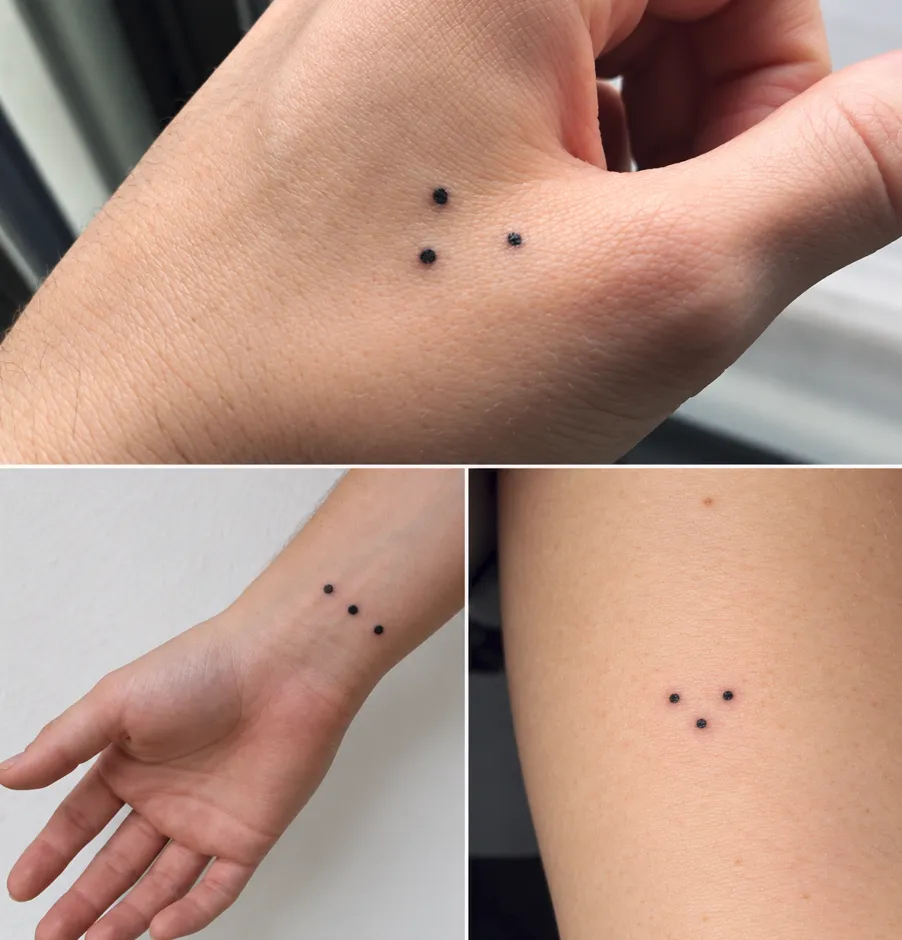
The three-dot tattoo may look extremely simple, but its meaning can be much more complex than the design itself.Made up of only three small dots, this minimalist tattoo has been used in different cultures, communities, and personal traditions for many years. Because of that, there is no single meaning that applies to everyone who wears it.For some people, the tattoo represents a personal philosophy. For others, it may reflect an important chapter in life, a difficult experience, a reminder of personal growth, or simply a preference for subtle body art.That is why the three-dot tattoo is often misunderstood. It is easy to look at a small symbol and assume it has one fixed meaning, but tattoos are usually far more personal than that.A Small Design With Many InterpretationsOne reason the three-dot tattoo has remained popular is its simplicity.It can be placed almost anywhere on the body, including the hand, wrist, fingers, arm, or other small areas where a larger tattoo might not fit comfortably.Despite its small size, the design can still carry strong personal meaning.Minimalist tattoos have become especially popular because they allow people to express an idea without needing a large or highly detailed image. A few simple marks can sometimes represent an entire experience, belief, or memory.With the three-dot tattoo, the meaning often depends on the person wearing it rather than the design alone.The Connection to the “Three Wise Monkeys”One interpretation sometimes linked to the three-dot tattoo is the traditional idea of the “Three Wise Monkeys.”This concept is commonly associated with the expressions:See no evil, hear no evil, speak no evil.For some people, the three dots may serve as a reminder to act with self-control, avoid unnecessary negativity, and think carefully about what they see, hear, or say.In this interpretation, the tattoo can represent awareness, discipline, wisdom, and the desire to live more thoughtfully.However, not everyone with three dots uses the tattoo in this way.The same symbol can represent something entirely different depending on personal beliefs and cultural background.“Mi Vida Loca” and Another Well-Known MeaningIn some places, the three-dot tattoo has also been associated with the Spanish phrase “Mi Vida Loca,” which translates to “my crazy life.”For some wearers, this meaning can reflect a life filled with unpredictable experiences, difficult periods, major changes, or lessons learned through hardship.It does not always mean that the person is celebrating chaos or trouble.Instead, the tattoo may represent survival, resilience, acceptance of the past, or the ability to keep moving forward after difficult moments.For that reason, the three dots can become a deeply personal symbol of someone’s life journey.Placement Can Also MatterThe tattoo is often seen on the hand, especially near the thumb or between the thumb and index finger.It may also appear on the wrist, fingers, forearm, or other visible areas.Some people intentionally choose a visible location because they want the tattoo to act as a daily reminder.Others simply like how the design looks in a small, clean space.The placement does not automatically determine the tattoo’s meaning, but it can sometimes add to its personal significance.Why You Should Not Judge the Meaning Too QuicklyBecause the three-dot tattoo has been used in different environments and cultures, people sometimes make assumptions when they see it.That can be misleading.A person may have chosen the tattoo because of family, personal experiences, spirituality, artistic preference, or an important memory. Someone else may have chosen the exact same design for a completely different reason.This is true of many tattoo symbols.Their history may provide clues, but the final meaning usually belongs to the person wearing them.Tattoos Have Become More Personal Over TimeAs tattoo culture has become more common, traditional designs have increasingly been given new meanings.Many people today do not choose tattoos because of an established historical definition. Instead, they take an existing symbol and give it their own interpretation.That is especially common with minimalist tattoos.A design as simple as three dots can represent friendship, family, personal growth, important stages of life, or something known only to the person who wears it.This flexibility is part of what keeps the design popular.The Meaning Is Ultimately PersonalThe three-dot tattoo proves that a tattoo does not need to be large or complicated to carry meaning.For one person, it may represent wisdom and self-control.For another, it may symbolize resilience, life experience, or a difficult chapter they survived.Someone else may simply like the clean, minimalist appearance of the design.There is no universal explanation that fits everyone.The best way to understand a tattoo is not to judge it by appearance alone, but to recognize that the story behind it may be far more personal than the symbol itself.In the end, three small dots can mean many different things — and sometimes, their true meaning is known only to the person wearing them.

Sep 29, 2026
Can You Spot the Hidden Difference in This Mind-Bending Puzzle? New

Can You Spot the Hidden Difference in This Mind-Bending Puzzle?

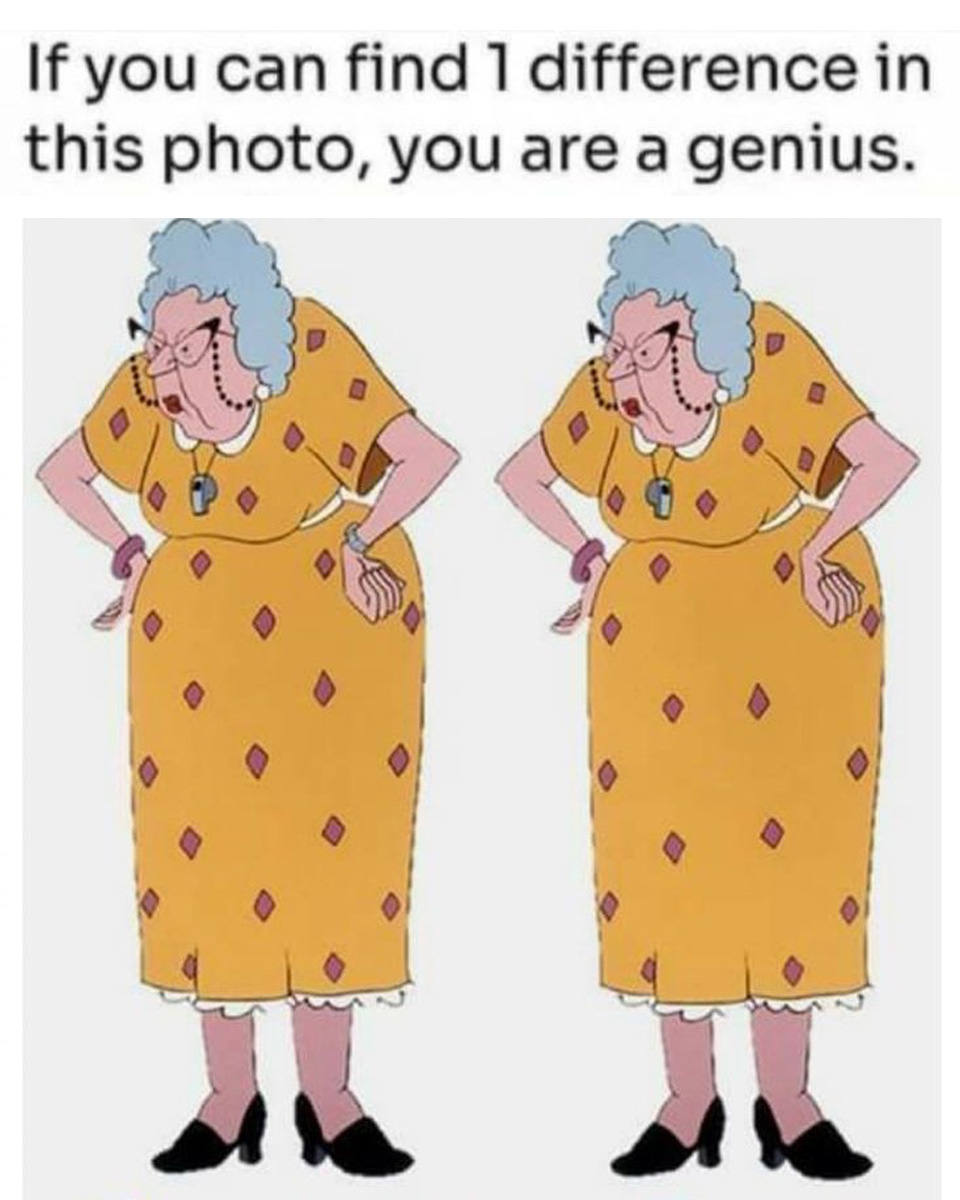
Hello there, friends.We have a picture for you that looks very familiar.Actually, it looks more like a mirror image.You are seeing two identical pictures of a stern, perhaps familiar, lady.She looks like a character from a popular animation, doesn’t she?This is a classic “spot the difference” puzzle.It is a game of visual acuity.Your entire task is to find the single thing that is not the same between the left side and the right side.Only one single item.It sounds extremely simple, right?But simple is not always easy.The entire picture is designed to be a clever visual deception.Your eyes and brain work together in an incredible way.They help you make sense of the world very quickly.Most of the time, this quick processing is a very good thing.It helps you read text rapidly and cross the street safely.But sometimes, your brain can be too efficient.When faced with two similar pictures, it tries to fill in the gaps.It sees the shapes, colors, and overall composition.Then it makes a conclusion. “These look the same.”This quick decision is your biggest enemy here.You have to actively resist it.To solve this, you can’t just glance.You must look.Look very closely.Don’t look at the image as a single picture.You must become a digital detective.Think of it as looking at a painting, brushstroke by brushstroke.Scan the image from top to bottom, one small area at a time.Or try to scan it from left to right, comparing the corresponding sections.Start with the character’s blue, curly hair.Then, check her expressions and glasses.Scan her yellow dress and its red diamond patterns.Compare her pink stockings and small black shoes.Check the background and all the whitespace.Don’t miss the small accessories and details.Every pixel must be accounted for.I cannot give you any clues to the exact location of the difference.That would ruin all the fun and a sense of achievement.You need to feel that little ‘ping’ of satisfaction on your own.Once you see it, you will probably be surprised.You might even laugh at yourself for not seeing it sooner.It might feel like the difference was always waving at you, yet you missed it.This is a very common feeling with these types of puzzles.They are designed to hide in plain sight.Finding it on your own is like unlocking a level in your mind.I won’t share the answer here.That is entirely for you to discover.Take as much time as you need.There is absolutely no rush.Let your focus deepen and trust your perception.When you think you’ve found it, look closer one last time.Can you be sure?If you can indeed spot it, you have done something very clever.It means your eyes and your mind are working in perfect, sharp harmony.It proves that you have the patience to focus.You are not easily distracted by broad strokes.I can confirm that the difference is absolutely there.It isn’t a trick question; there is a real, distinct change.Your brain can find it.Good luck on this little hunt.I hope you enjoy the moment of discovery.Now, go find it!ANSWER:

Sep 29, 2026
The Shocking Betrayal That Left Family Ties in Ruins New

The Shocking Betrayal That Left Family Ties in Ruins

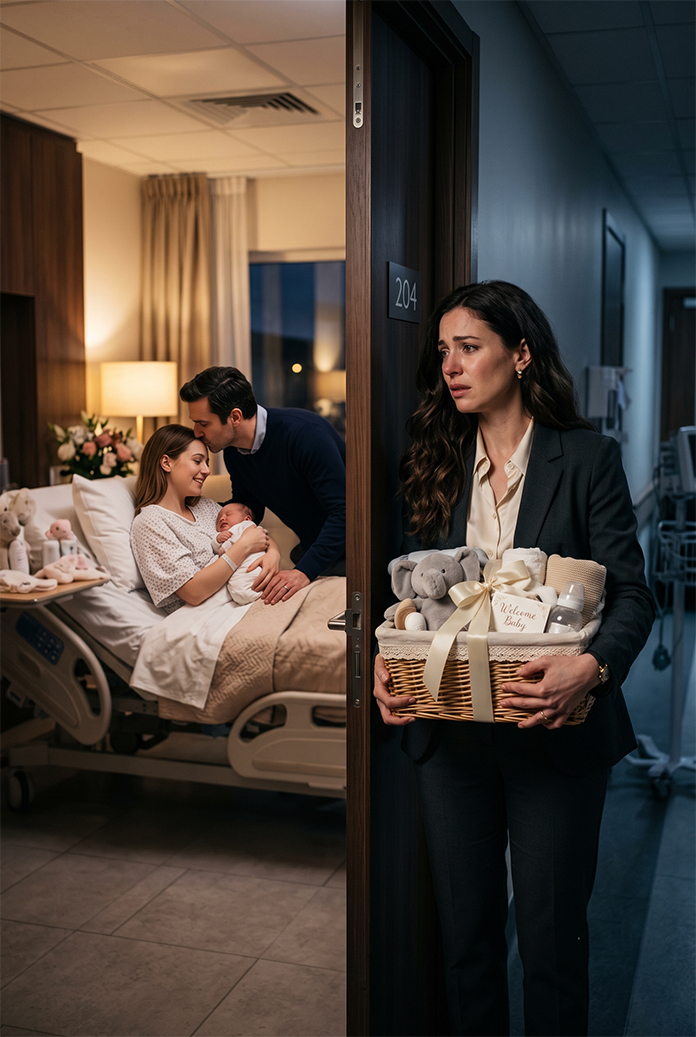
I arrived with gifts for my newborn nephew and overheard my husband tell my sister, “Her husband will pay the bills, and our son will carry my name.” I left unseen. Days later, when my mother demanded $180,000 for the hospital, I smiled and said, “Sure,” because I had already discovered that the betrayal went far beyond an affair.“Our son will carry my last name. Julian can keep paying until we’re ready to leave.”I heard my husband, Cole, say those words while kissing my younger sister on the forehead.They were less than 10 feet away.I stood outside Tessa’s private maternity suite holding a $1,500 gift basket filled with embroidered blankets, expensive baby clothes, and a silver rattle.The door was slightly open. Neither of them could see me.“Julian looks at the baby as if he belongs to him,” Tessa whispered. “I don’t know how much longer I can pretend.”“A few more weeks,” Cole replied. “Once Mara sells her company shares and transfers the condo, we’ll have enough. Then it’ll be you, me, and our son.”“And Mara?”“She’ll survive. She always does.”My name is Mara. I was 32 and worked as a senior financial risk analyst in Manhattan. In my family, I had always been known as the responsible one.That meant I paid for emergencies, repaired everyone’s mistakes, and remained silent whenever my younger sister received something that had originally been promised to me.When Tessa abandoned college, my parents used part of my education fund to settle her debts. When she demanded a destination wedding, I contributed $45,000. When she became pregnant, my mother said I should help because I had a successful career.The cruelty was worse because my family knew Cole and I had endured 2 unsuccessful fer:tility treatments. My mother had held me while I cried after the second attempt failed.Now she was helping my sister celebrate my husband’s child.Inside the room, Cole laughed softly.“Mara thinks Brightwell has outside investors. She won’t realize she financed us until we’re gone.”I stepped backward.I wanted to enter the room and confront them, but my work had taught me something important: the person who panics first usually reveals the least and loses the most.I carried the basket to the elevator, descended to the parking garage, and dropped it into a trash bin.Inside my car, I opened our joint bank account.There should have been almost $160,000 in savings.Only $5,416 remained.Three days earlier, Cole had transferred $142,800 to Brightwell Medical Ventures, the healthcare company he claimed to be building with investors.Public formation records showed that Brightwell shared an address with another company called Cedar Bridge Patient Services. Both had been created recently using the same registered agent.Before I could investigate further, a message from my mother appeared.Deposit $12,000 tomorrow. Tessa’s hospital suite still has a balance. She just gave birth, Mara. Do your part.I looked back at the hospital.My husband and sister were planning a new life with their child while my mother demanded that I pay for the room where they celebrated.I typed 1 word.Sure.Then I drove home and began investigating my own marriage.My credit report showed 3 cards I had never opened and an unfamiliar hard inquiry from a commercial lender.The cards carried more than $38,000 in charges.I froze my credit, contacted the issuers, and called the lender’s fra:ud department. After confirming my identity, they sent me the loan application through a secure portal.Someone had applied for a $750,000 business loan using my income and property as security.Attached was a document titled:MORTGAGE, PERSONAL GUARANTEE, AND COLLATERAL ASSIGNMENT.It pledged the downtown condo I had purchased before marrying Cole, along with my rental income and vested company shares.My signature appeared on every required page.I had not signed any of them.Beneath my signature was my mother Lucille’s notary stamp. She had certified that I signed the document in her presence on a Wednesday afternoon.That afternoon, I had been speaking at a conference in Toronto in front of more than 400 people.My father, Franklin, was a licensed property appraiser. He had submitted a valuation that overstated my condo’s value by nearly $300,000.He filed it through his appraisal company without disclosing that I was his daughter—or that he would personally profit if the loan closed.The lender’s ownership disclosures identified Tessa as Brightwell’s managing member and Cole as its financial director.The final payment schedule revealed the part they never expected me to see.After the loan was funded, my parents would each receive a $50,000 “consulting distribution.”My husband had for:ged my signature.My mother had fal:sely notarized it.My father had submitted a dishonest appraisal while concealing his financial interest.My sister controlled the company that would receive the money.All 4 of them were involved.I saved the documents in several secure locations and called Priya Desai, an attorney specializing in financial fra:ud and high-asset divorces.By the following afternoon, we had disputed the cards, alerted my employer, stopped the loan, redirected my salary, and requested an emergency order preventing Cole or Brightwell from moving the remaining money.Priya gave me one instruction.“Don’t confront them yet. Let them believe you’re cooperating.”That evening, Cole came home carrying flowers.He wrapped his arms around me and told me he had missed me.I could smell Tessa’s perfume on his jacket.“I need 1 final investment for Brightwell,” he said. “If you sell your company shares, we can finally have the future we’ve talked about.”“How much?”“About $250,000.”“And my condo?”He hesitated.“Tessa needs somewhere stable to raise the baby. You don’t use it.”“It’s worth more than $1 million.”“We’re family, Mara. Stop treating everything like a transaction.”I smiled at him.“I’ll speak with my adviser.”The relief on his face told me he believed he had won.At 2:10 the next morning, I met Julian at a diner near the hospital.He looked exhausted. He had worked double shifts for months to pay Tessa’s supposed medical expenses.I showed him the travel records first.Tessa had told him she was attending a prenatal wellness retreat in the Catskills. Cole had reported an investor meeting at the same resort.There were matching trips to Miami and Charleston.The same dates.The same hotels.Different lies.Julian pushed the papers away.“Tessa has made mistakes, but she’s my wife.”“Then look at the hospital statements.”The invoices Tessa had given him directed payments to Cedar Bridge Patient Services. The company shared an address, registered agent, and bank with Brightwell.Julian called the hospital himself. As Tessa’s husband, insurance subscriber, and billing guarantor, he was authorized to discuss the account.The genuine remaining balance—including the suite, specialist care, and an extra night of newborn monitoring—was $14,263.Julian had already sent more than $34,000 to the fake billing company.Then he asked the question I had been dreading.“Is the baby Cole’s?”I told him what I had overheard.Julian covered his face with both hands.When he finally looked up, his eyes were red.“Help me prove it.”After consulting his attorney, Julian arranged a chain-of-custody cheek-swab test through an accredited laboratory. Because he was still the child’s presumed legal father, he was authorized to consent to the initial testing.The result would take several days. A court-ordered test would still be required to establish paternity legally, but the private result could tell him whether his suspicions were justified.Meanwhile, the bank froze $118,000 that remained in Brightwell’s account. The rest had already been spent on hotels, jewelry, business fees, and a deposit on a lakefront house.The purchase contract listed Tessa and Cole as the buyers.They were not planning to build a company.They were building a new life with our money.Ten days after the hospital, my mother called.“Tessa’s final bill has arrived,” she announced. “There were complications, specialist fees, newborn monitoring, and private nursing.”“How much?”“$180,000.”I muted the call so she would not hear my reaction.The hospital had already confirmed the real balance.“Send me the invoice.”“You don’t need to inspect every detail.”“My adviser won’t release that amount without documentation.”Twenty minutes later, she emailed me an altered hospital statement directing the full $180,000 to Cedar Bridge.The money was not meant for the hospital.It was the remaining down payment on Cole and Tessa’s lakefront house.My mother called again.“Well?”“Sure,” I replied. “But because I’m investing in a private company, my attorney and brokerage compliance department require signed ownership and use-of-proceeds declarations from every manager and financial beneficiary.”“What does that mean?”“Everyone confirms who controls the companies, who will receive money, and how the funds will be used.”She hesitated.Then greed defeated caution.“All right.”We arranged to meet at my parents’ house on Saturday.Cole sat beside me at the dining table. Tessa arrived with the baby and left him upstairs with a hired newborn nurse.My parents placed the for:ged mortgage and fa:ke hospital invoice in front of me.I handed each of them a declaration prepared with Priya’s guidance.The language was clear.Cole certified that I had knowingly approved the business loan and pledged my condo.Tessa certified that Cedar Bridge was a legitimate medical billing company and that the $180,000 would be used only for verified hospital expenses.My mother confirmed that she had personally witnessed my signatures.My father confirmed that his appraisal was independent and that he had no undisclosed financial interest.They read the documents.Then all 4 of them signed.My mother pushed the papers toward me.“Now transfer the money.”I gathered the declarations.“No.”Cole stared at me. “What?”“The money isn’t coming.”“You just made us complete all that paperwork.”“I needed you to confirm your lies in writing.”I placed copies of the genuine hospital statement, the lake-house contract, and the for:ged mortgage on the table.Cole’s face lost its color.“The Brightwell account is frozen,” I said. “The $750,000 loan has been stopped. The credit cards are under investigation, and my condo cannot be transferred.”Tessa stood so quickly that her chair fell backward.“You had no right to investigate my company.”“You used my identity to finance it.”“It was temporary,” Cole said. “We would have repaid everything.”“With what?”He had no answer.My father struck the table.“You’re destroying this family over money.”“You for:ged documents to take my home.”“We were protecting Tessa,” my mother snapped.“From what?”“From being trapped in an unhappy marriage.”Her answer was careful, but her fear told me she knew far more.Before I could respond, Julian appeared in the doorway.Tessa froze.He entered holding the accredited laboratory report.The result excluded him as the baby’s biological father.“This has to be wrong,” Tessa whispered.“A court can test us again,” Julian replied. “But we both know what the result will be.”“It was a mistake.”“A mistake doesn’t last more than a year.”Cole stood.“This is between us.”“You made it my business when you let me work 90-hour weeks to pay for your child.”My mother looked at the table. My father said nothing.Neither of them appeared surprised.That was when I knew they had not merely discovered the affair recently.They had known for much longer.My phone lay face down beside me, recording the conversation.Cole noticed it.“Delete that.”“No.”He stepped closer, but my father stopped him.“Mara,” my father said, lowering his voice, “think carefully. You don’t have children. Someday, your property would have returned to the family anyway.”I stared at him.“So you decided to take it now?”“We were making sure the baby had a future.”“With my home and my money.”My mother lifted her chin.“You have always had more than Tessa.”“Because I worked for it.”“You had opportunities she didn’t.”“She had every opportunity I had. You simply protected her from every consequence.”Silence filled the room.For the first time, I understood how they saw me.Nothing I earned truly belonged to me. My success was only a family resource waiting to be transferred to their favorite daughter.I placed 4 envelopes on the table.They contained copies of the divorce filing, civil fra:ud claims, lender reports, and demands to preserve every financial record.“Official service will happen separately,” I said. “These copies are so none of you can pretend you were surprised.”Cole opened his envelope.“Mara, don’t do this.”“You already did.”I walked outside.A licensed process server was waiting near the gate.The investigation uncovered more than I expected.Subpoenaed messages showed that my parents had known about Cole and Tessa’s affair for almost a year.My mother had discovered them together before Tessa became pregnant.Instead of telling Julian or me, she decided Cole was better suited to her favorite daughter. My father then began designing the financial plan that would allow them to leave both marriages with enough money to start over.They intended to empty our savings, borrow against my condo, collect their consulting payments, and disappear before I understood what had happened.The fake hospital bills were a convenient way to extract money from both Julian and me.Investigators also found messages discussing my fer:tility struggles.My mother had written:Mara won’t fight too hard once we remind her the property will eventually benefit the only grandchild.My father had created spreadsheets showing how my assets would be divided after Cole left me.One column was labeled Mara settlement risk.Another was labeled family recovery.The for:ged mortgage had not merely threatened my home.It had provided investigators with a map connecting everyone involved.The credit-card issuers removed the unauthorized charges. The frozen $118,000 was restored to the marital estate and ultimately credited to me in the divorce settlement. The lake-house deposit was attached through the civil case and used toward repayment.Cole and Tessa faced charges connected to identity the:ft, fal:sified business records, and attempted financial fra:ud.My mother lost her notary commission and faced consequences for the false notarization. My father’s appraisal license was suspended after investigators proved that he concealed both our relationship and his financial interest.The court-ordered paternity test confirmed the private result.Cole was the baby’s father.Julian filed for divorce and was eventually removed from legal and financial responsibility for the child. He never blamed the baby.Neither did I.The child was innocent.The adults had built the deception around him.My divorce took 11 months.During mediation, Cole sat across from me and said, “Tessa and I aren’t together anymore.”Their relationship had collapsed as soon as the money disappeared.I felt nothing.“You ruined our future,” he said.“No. I stopped you from purchasing it with mine.”He signed the settlement.I sold the house I had shared with Cole and moved into the condo my family had tried to steal.My mother sent letters saying Tessa was struggling and the baby deserved stability.Through my attorney, I offered to pay verified emergency pediatric expenses directly to medical providers.My mother refused.She wanted cash.That told me nothing had changed.Julian eventually moved to another city and accepted a position at a children’s cardiac center. Before leaving, he met me for coffee.“I’m sorry I defended her that first night,” he said.“You loved who you believed she was.”“So did you.”For years, I had feared that setting boundaries would leave me alone.I finally understood that I had already been alone—surrounded by people who kept me too busy solving their problems to notice.The baby eventually received Cole’s last name, exactly as Cole had promised my sister in that hospital room.But there was no lakefront house.There was no $750,000 loan.There was no successful company or secret fortune.There were only legal bills, repayments, ruined reputations, and the consequences of believing the responsible daughter would remain obedient forever.They had mistaken my calmness for weakness.They had mistaken my silence for ignorance.And when I said, “Sure,” they believed I had agreed to give them another $180,000.I hadn’t.I was giving them enough confidence to put every lie in writing.


Sep 29, 2026
Young Doctor's Unconventional Diagnosis Leaves Community Buzzing New

Young Doctor's Unconventional Diagnosis Leaves Community Buzzing

A young doctor moved out to a small community to replace a doctor who was retiring.The older doctor suggested that the young one accompany him on his rounds, so the community could become used to a new doctor.At the first house, a woman complains, “I’ve been a little sick to my stomach.”The older doctor says, “Well, you’ve probably been overdoing the fresh fruit. Cut back on the amount you’ve been eating and see if that does the trick?”As they left, the younger man said, “You didn’t even examine that woman? How do you come to the diagnosis so quickly?”“I didn’t have to. You noticed I dropped my stethoscope on the floor in there? When I bent over to pick it up, I noticed a half dozen banana peels in the trash. That was what probably was making her sick.”The younger doctor said, “Pretty clever. If you don’t mind, I think I’ll try that at the next house.”Arriving at the next house, they spent several minutes talking with a younger woman. She said that she just didn’t have the energy she once did and said, “I’m feeling terribly run down lately.”“You’ve probably been doing too much for the church,” the younger doctor told her. “Perhaps you should cut back a bit and see if that helps.”As they left , the elder doctor said, “I know that woman well. Your diagnosis is most certainly correct, she’s very active in the church, but how did you arrive at it?”“I did what you did at the last house. I dropped my stethoscope and, when I bent down to retrieve it, I noticed the pastor under the bed.================================================Oliver`s wife, Amelia, and kids all came down with the flu.Upon returning home from the pediatrician`s office with his four kids, he turned his attention to his ailing wife.After preparing some chicken soup for her, he picked up the phone to call her doctor.The receptionist picked up and he related the situation to her. She then told him that the office was going to be closed for a couple of days, but that his wife could have an appointment in 3 days.Oliver went ballistic and yelled into the phone, “Three days?! The doctor can`t see her for three days?! She could be dead by then!”Calmly the voice at the other end of the line replied, “If so, would you please call to cancel the appointment?”================================================A man hasn’t been feeling well, so he goes to his doctor for a complete checkup.Afterward, the doctor comes out with the results.“I’m afraid I have some very bad news,” the doctor says. “You’re dying, and you don’t have much time left.”“Oh, that’s terrible!” says the man. “How long have I got?”“Ten,” the doctor says sadly.“Ten?” the man asks. “Ten what? Months? Weeks? What?!”“Nine…”

Sep 29, 2026
Meghan Markle's Bold Move: Lilibet's Portrait Shakes the Royal Foundations New

Meghan Markle's Bold Move: Lilibet's Portrait Shakes the Royal Foundations

The world held its breath as the Duchess of Sussex did the unthinkable, shattering years of carefully constructed silence with a single, earth-shattering post. Meghan Markle, long the guardian of her children’s anonymity, finally pulled back the curtain on her daughter, Lilibet Diana, and the public was left reeling. As the photo hit the digital sphere, the British establishment trembled. With a bold declaration regarding her daughter’s unmistakable red hair and a cryptic, heart-stopping insinuation about Lilibet’s biological father, Meghan has ignited a firestorm that threatens to dismantle the monarchy’s most intimate secrets and rewrite the history of the House of Windsor forever.For years, the Duke and Duchess of Sussex have navigated a complex path, balancing their desire for public service with a fierce, unwavering commitment to the privacy of their children, Archie and Lilibet. The Sussex household has often been described as a fortress, where the prying eyes of the global press were kept at bay, and the milestones of their young family were celebrated away from the glare of tabloid spotlights. This protective instinct, while often criticized by those hungry for royal content, was always framed by the couple as a necessary sacrifice for their family’s mental health and emotional well-being.However, the recent release of a candid, sun-drenched portrait of the four-year-old Lilibet has signaled an unprecedented shift in their strategy. The image, which captured the young royal in a quiet moment in a sprawling, verdant garden, acted as a visual earthquake. Dressed in a simple, delicate white dress and clutching a modest bunch of hand-picked daisies, the toddler appeared the picture of innocence. Yet, it was the context of the reveal—and the explosive nature of the accompanying caption—that transformed a simple social media post into a historical event. Meghan’s words were carefully chosen, layered with enough emotional gravity to anchor the photo, but also draped in a sense of mystery that invited endless speculation.The reaction from the British public and royal observers was immediate and overwhelming. For decades, the visual markers of the Windsor line have been studied with intense scrutiny; physical traits are treated as tangible evidence of heritage and legitimacy. When Meghan drew direct attention to her daughter’s vibrant red hair, she was doing far more than sharing a proud mother’s observation. In the context of the royal family, where the iconic ginger hue has been a signature trait of Prince Harry’s throughout his life, the focus on this specific physical feature felt like a deliberate challenge to the rumors and whispers that have dogged the couple since their departure from royal duties.By framing Lilibet as “a reflection of love and strength,” Meghan moved the conversation beyond mere physical appearance. She positioned her daughter as a symbol of the very life the Sussexes have sought to build outside the confines of rigid tradition. This was not just a picture of a child in a garden; it was a political statement. It was a reclaiming of the narrative, asserting that their daughter belongs to their chosen path, governed by their own values rather than the expectations of an institution they feel compelled to distance themselves from.The choice of platform and the timing of the release also suggested a calculated move. In an era where digital engagement is the primary currency of influence, the couple bypassed traditional press channels, choosing instead to speak directly to the people. This bypass of royal protocols has become a hallmark of their post-royal career, but this instance felt different. It carried the weight of a peace offering, or perhaps a warning. The image invited the world to see the humanity of the child, hoping, perhaps, that the innocence captured in the frame would temper the vitriol that has frequently characterized the public discourse surrounding her parents.Observers were quick to note the striking resemblance between Lilibet and her late grandmother, the incomparable Princess Diana. The soft, gentle expression captured in the portrait sparked waves of nostalgia among those who have long seen the Sussexes as the torchbearers of Diana’s legacy. This connection to the “People’s Princess” is a powerful tool in the court of public opinion, one that the Sussexes have utilized to humanize their struggle and ground their narrative in the history of the family they left behind. When people look at Lilibet, they do not just see a young girl; they see the ghost of a history that remains deeply unresolved.The implications of this revelation ripple outward, touching upon the fragility of the relationship between the Sussexes and the monarchy. Could this be the olive branch that triggers a genuine reconciliation? Or is it a strategic maneuver designed to show the world that the Sussexes are flourishing, unburdened by the requirements of their former royal life? The discourse has been dominated by debates over heritage, biological markers, and the inherent tensions of living under a microscope.The photograph has forced a reckoning with how the public consumes the lives of the royal family. It highlights the tension between the desire for transparency and the right to a private life. For the royal family, who operate on the principles of stability and continuity, the individualistic expression of the Sussexes represents a modern threat to their carefully maintained image. Meghan and Harry have proven that they are willing to redefine the terms of engagement, moving the goalposts whenever they feel their family’s integrity is at stake.As the dust settles, one thing remains clear: the image of Lilibet has become a pivotal document in the ongoing saga of the modern British monarchy. It serves as a reminder that behind the titles, the political maneuvering, and the global headlines, there are real people navigating the complexities of identity and belonging. Whether this act was one of defiance, love, or a masterclass in modern public relations, it has succeeded in its goal: it has refocused the world’s attention on the Sussexes, ensuring that their voice remains the loudest in the room. The red hair, the daisies, and the garden serve as the backdrop for a much larger, more enduring story—one that is far from its final chapter.

Sep 29, 2026